


The FeedingBird Journal
Fresh perspectives on estate planning, the moments that matter, and what we’re building at FeedingBird.

Conversations Worth Having

Your will doesn't control everything. Learn why beneficiary forms on 401(k)s, IRAs, and life insurance can override your will, and what to check today.
You've probably seen Ocean's Eleven, or some version of it. Danny Ocean puts together a crew to pull off a casino heist, and here's the thing people forget: Danny doesn't crack the safe himself. He doesn't hack the cameras or pose as a casino employee either. He's the planner. Each specialist runs their own piece, following their own rules, and the whole job only works because everyone does their part.
Your estate plan works almost exactly the same way. Most people don't realize it until it's too late to fix.
This Week's Legal Insight
People assume their will is the entire crew, one document running the whole show, deciding who gets what. It isn't. Your will is the planner. It's essential, but it doesn't control the distribution of every asset you own. Different assets have their own specialists, their own rules, operating completely independently of what your will says.
There are three departments handling your stuff after you're gone.
Probate Assets
Things titled only in your name with no one else named to receive them: a car with just your name on the title, a regular checking account with no "payable on death" person listed, personal belongings. These go through your will, or if you don't have one, state law decides. This is the one department your will actually manages directly.
Contractual, or Non-Probate, Assets
Accounts where you named a specific person to receive them: life insurance policies, 401(k)s, IRAs, and bank accounts marked "payable on death" or "transfer on death." These pass by contract, straight to whoever's name is on that beneficiary form, regardless of what your will says. Your will has zero authority here.
Jointly Owned Assets
Property or accounts owned with someone else that include survivorship rights, like a house owned jointly with a spouse. These usually pass automatically to the surviving co-owner the moment you die, no will required.
Wait, Really?
Yes, really. If your will says your spouse gets everything, but your 401(k) beneficiary form still lists your ex from ten years ago, your ex gets that account. Not your spouse, not your kids. Courts have consistently upheld the beneficiary form over the will in this exact situation. The will simply doesn't have jurisdiction over that department.
In Simple Terms
● Probate is the court process that oversees distributing assets that don't already have a named recipient.
● Beneficiary designation is the person you've told a specific account, like a 401(k) or life insurance policy,
to go to when you die.
● Contractual asset is an asset governed by a form you filled out, not by your will. The form is essentially a
private contract between you and the company holding the account.
A Family, Just to Make It Real
A will that says all the right things can still get completely overridden by an outdated form sitting in a file
somewhere. This isn't rare, it's one of the most common estate-planning mix-ups there is, especially after a divorce,remarriage, or a job change where you rolled over a retirement account and never revisited the paperwork. Rules can vary by state, but this basic hierarchy, contract beats will, holds true almost everywhere in the U.S.
Picture someone who updated their will right after a divorce, naming their new spouse. They never thought to open the old 401(k) paperwork sitting in a drawer, still listing their ex. Years later, that's the form that wins.
The Takeaway
Your will is the planner, not the whole crew. Some of your biggest assets, retirement accounts, life insurance, jointly owned property, answer to a different set of instructions entirely, ones you may have filled out once and never looked at again.
One Thing to Check This Week
Pull up the beneficiary designations on your retirement accounts and life insurance policies. Compare the names listed there to what your will says. If they don't match, that's worth a closer look.
A Question to Ask Your Family
"Do you know which of your accounts already have someone named to receive them, separate from whatever your will says?"

A living will puts your medical wishes in writing so your family never has to guess. Learn what it does, what states call it, and why to plan early.
Most of us have walked past a fire evacuation map posted in a hotel hallway or an office breakroom without giving it much thought. But the buildings that actually run fire drills, the ones where people walk through the plan before smoke ever fills a room, are the ones where everyone knows exactly what to do when it counts. No confusion. No wasted time. Just people moving because the plan was already in place.
That's the idea behind this week's insight. An attorney told us something worth sitting with: most people don't plan for the hard stuff until they're already in the middle of it.
Living Wills, Explained
Ever heard of a "living will"? Depending on where you live, it might go by a different name. Some states call it a "declaration." Others call it a "directive to physicians," or fold it into a larger document called an "advance directive." Same basic idea, different label.
Here's what it actually does: a living will lets you write down, ahead of time, what kind of medical care you do or don't want if you're ever seriously ill or injured and can't speak for yourself. Things like whether you want to be kept on life support, or what "quality of life" means to you. Hard questions. The kind nobody wants to think about until they have to.
That's the real problem. Most families don't fill these out early. They wait, hoping they'll never need to. Then a crisis hits, and suddenly everyone is guessing what their loved one would have wanted.
This is exactly where FeedingBird comes in. Every state treats these documents a little differently, but FeedingBird brings all of those state-specific choices into one place. Instead of guessing, your family already has your answers, spelled out clearly, long before a crisis ever happens.
A Family, Just to Make It Real
Meet the Coopers. Mr. Cooper always said, "My family knows what I want." He never wrote anything down. Then a car accident left him unable to communicate, and his three kids sat in a hospital hallway, each one sure they knew Dad's wishes, and each one remembering it differently. What should have been a moment of comfort turned into days of painful disagreement, all because nothing was ever put in writing.
The Coopers - No Living Will

Contrast that with the Patels next door, who filled out their living wills two years earlier using FeedingBird. When Mrs. Patel had a stroke, her daughter didn't have to guess. She opened one document, and there it was: Mom's wishes, in Mom's own words. No arguing. No guessing. Just clarity, right when it mattered most.
The Patels - FeedingBird Users

The Analogy
Think about a fire drill again. No one waits for smoke before planning the exits. The plan gets made ahead of time and walked through, so when it actually matters, there's no scrambling and no guessing. Everyone already knows what to do.
A living will works the same way. You're not trying to figure things out in the middle of a crisis. You've already decided, and the people you love already know the plan before anything happens.
The Takeaway
The hardest conversations are the ones worth having early, before a crisis, not during one, when everyone is overwhelmed.
A question for the week: if your family had to make a decision for you tomorrow, would they already know what you wanted, or would they be left guessing?
That's exactly the gap FeedingBird was built to close: one place to put your voice in writing, so the people you love never have to guess.

Think your trust protects you from nursing home costs? Many don't. Learn the real difference between revocable and irrevocable trusts before you need to know.
A private nursing home room now runs about $11,250 a month in most parts of the country, according to 2026 estimates from the American Council on Aging. In some states it is closer to $32,000. That is not a scare number, it is just the going rate for care many of us will need someday.
Here is the part that surprises people: a lot of folks who already have a trust assume they are covered for exactly this. Often, they are not. Not because their trust is bad, but because it was built to do a different job.
This Week's Legal Insight
Trusts generally fall into two families, and each one is built for a different purpose.
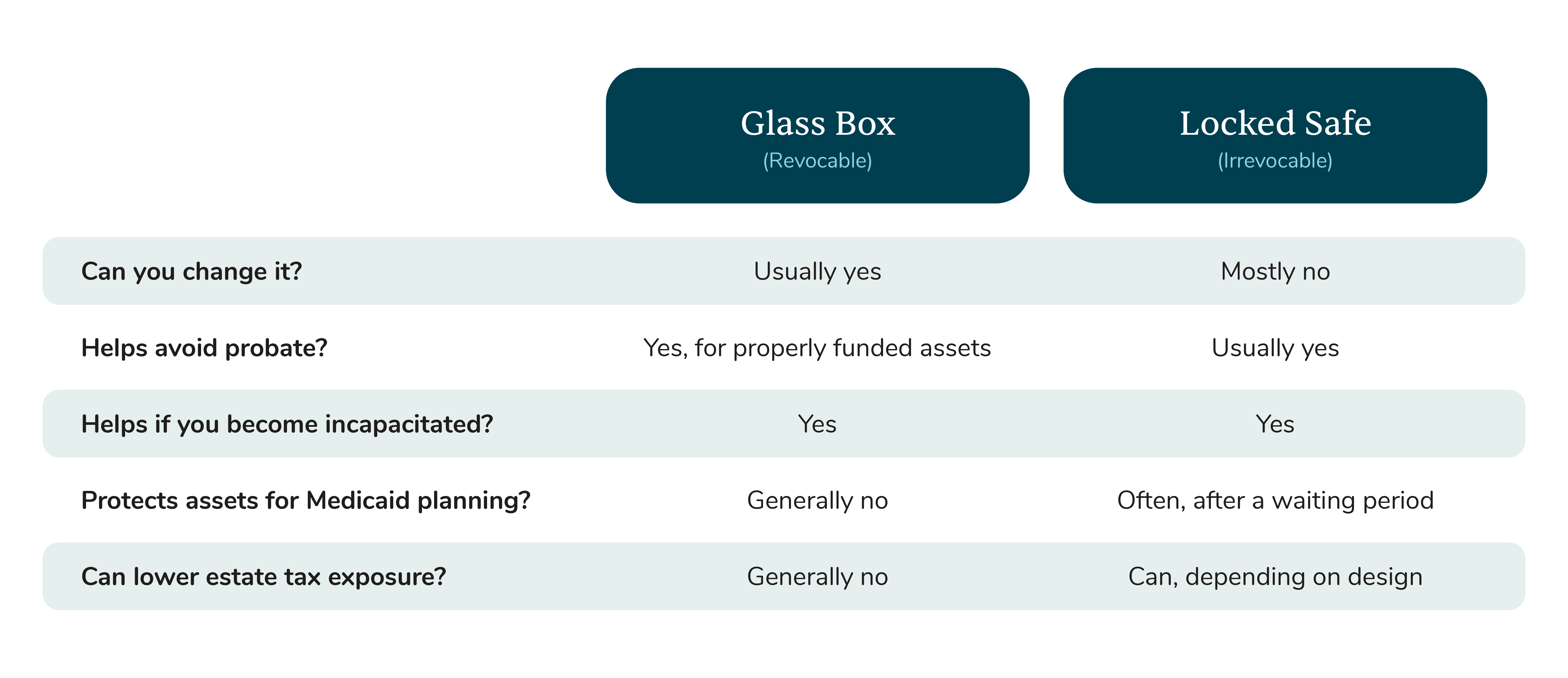
A revocable trust is like a glass box. You put your things inside, and you can still reach in, rearrange them, or take everything back whenever you want. You usually manage it yourself, and if you become incapacitated, a backup person you chose can step in without a court order. It is a great tool for avoiding probate and keeping your affairs private and organized.
An irrevocable trust is more like a safe with restricted access. You hand control to someone else to manage, and you generally cannot undo it or take the items back on your own. That loss of control is exactly why it can offer real protection, though the actual protection depends on how the trust is written.
The short version: control and protection pull in opposite directions. The more of one you keep, the less of the other you get.
A Family, Just to Make It Real
Ray is 71, a retired mechanic, and proud that he "did everything right." Three years ago he paid a lawyer to set up a trust. He tells his daughter Dana the house and savings are locked up safe.
Then his neighbor moves into a nursing home, and the bills start running thousands of dollars a month.
Dana: Dad, are you worried about the nursing home thing?
Ray: Nope. Everything's in my trust.
Dana: Can you still change the trust whenever you want?
Ray: Sure, that's the best part. I control everything.
Dana: Dad, that might be the problem.
If you can take assets back whenever you want, the law usually treats them as still yours. Ray built a great glass box. He just needed a safe too, and never knew it.
The Analogy
Think of estate planning like building a house, floor by floor, not starting at the top.
Floor 1 is the foundation: a will, a financial power of attorney, a healthcare directive, and up-to-date beneficiary designations. Floor 2 is knowing what you own and how it is titled. Floor 3 is the glass box, a revocable trust, for privacy and smooth handling if you are incapacitated. Floor 4 is the locked safe, an irrevocable trust, for people whose biggest worry is long-term care costs. Floor 5 is bringing in the right specialists: an elder law attorney, an estate planning attorney, a CPA, and a financial advisor.
Most people hear "irrevocable trust" and think it is step one. It is usually step four, and it comes with its own timing rules. Federal law applies a five-year look-back period for most Medicaid long-term-care transfers, so moving assets and needing care too soon can trigger a penalty period. That is a big part of why people who plan early, while healthy, end up with more options.
The Takeaway
A trust is not one tool, it is two different tools that happen to share a name. One is built for control and convenience. The other is built for protection, and it asks you to give up control to get it. Knowing which one you have, and whether it actually holds what you think it does, is worth checking today rather than during a crisis.
One Thing to Check This Week
Pull out your estate documents and find out whether your trust is revocable or irrevocable, and whether it was ever actually funded, meaning your house and accounts were retitled into it. An unfunded trust protects nothing, no matter what kind it is.
This is educational content, not legal advice. Trust and Medicaid rules vary by state, and a licensed attorney in your state can tell you what applies to your situation.

Prince died without a will or trust, leaving years of court battles. See how a revocable trust avoids probate, cost, and public exposure.
Prince died without a will or a trust. He left behind an estimated $200 million with no instructions attached. More than a decade later, people are still writing about it: the years of court battles, competing heirs, and every filing sitting in public record for anyone to read.
That's the part worth sitting with. Not that it happened, but how long it kept happening, in full view of the public, all because one document was never created.
Good to know: the revocable trust
A revocable trust lets you place your assets, home, investments, everything, into a trust you control during your lifetime. You can manage it, change it, or undo it entirely, as long as you're mentally competent. Nothing locks you in. That's the "revocable" part.
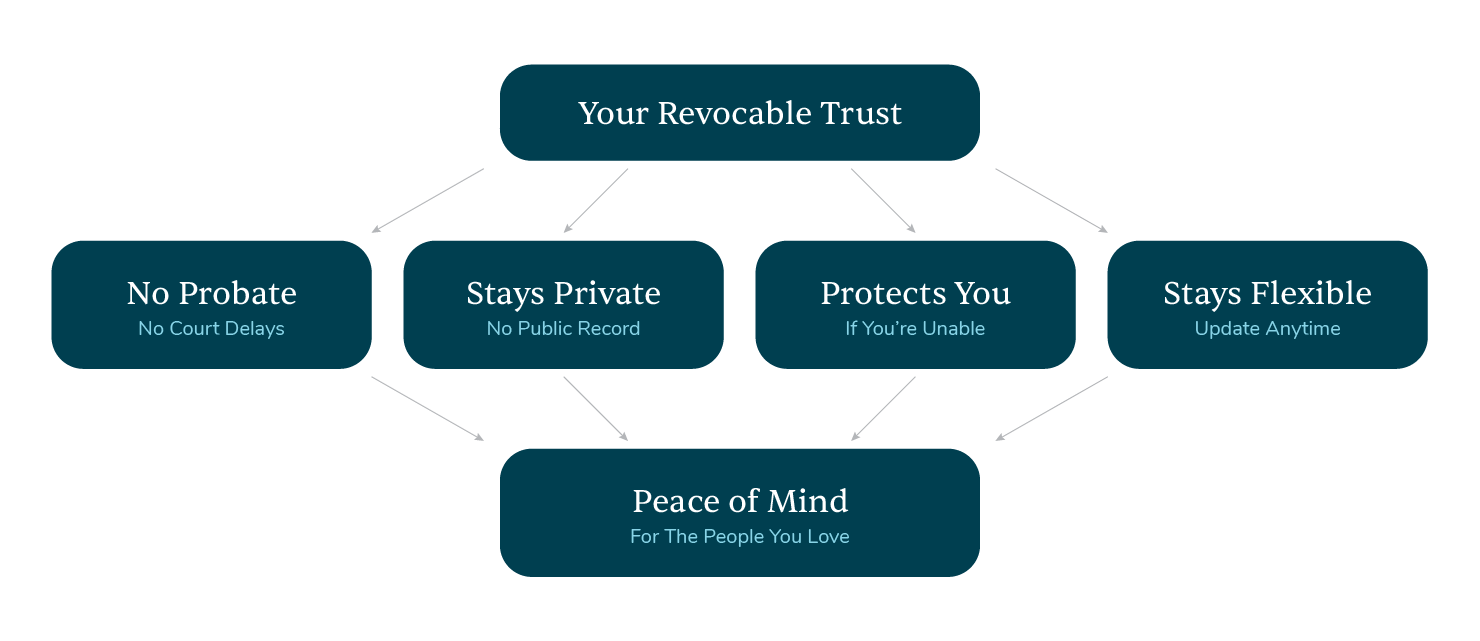
Four reasons attorneys point to it so often:
- No probate. A will typically has to go through probate, the court process that confirms it's valid before anything gets distributed. That can take months or years, and it costs money along the way. A properly funded trust skips it entirely.
- Stays private. A will becomes public record once it enters probate. Anyone can read what you owned and who you left it to. A trust isn't filed with any court. It stays private, the way Prince's estate never got to.
- Covers incapacity, not just death. If a stroke, accident, or illness leaves you unable to manage your affairs, your named successor trustee can step in immediately. No guardianship hearing, no waiting on a judge.
- Stays flexible. Life changes. A trust can be updated anytime, no courtroom required.
Making it real
The Delgados set up a trust in their 50s. When Mr. Delgado had a heart attack years later, his named successor trustee, his daughter, simply stepped in and managed things. No court filing, no public record. When he passed, the trust's assets moved directly to his family, privately, exactly as he'd planned it.
The short version
A will is like reading your diary out loud in a courtroom after you're gone. A trust is like keeping that diary in your own desk drawer, with clear instructions for someone you trust to handle it quietly.
Ask yourself: if something happened tomorrow, would your family's next steps already be private and planned, or would they be figuring it out in a courtroom?
That's what FeedingBird helps you build. A trust that's actually working when your family needs it, someone you trust already in place if life knocks you down for a while, and a plan you can update whenever things change. Private, flexible, ready.

In many states, a POA agent can't file bankruptcy for you unless it's specifically written in. See what powers your document may be missing.
Earlier this month, Hughes Satellite Systems, the satellite broadband arm of EchoStar, filed for Chapter 11 bankruptcy. The company owed $1.5 billion in bonds that had just come due, and rising competition from newer satellite networks made it impossible to keep up. So the company made a big, formal decision: file for bankruptcy and restructure.
Here's the thing about a decision like that: it doesn't happen by accident. A company can't just have some random employee decide to file for bankruptcy on a whim. It takes clear, deliberate authorization. Someone has to actually have the power to make that call, and it has to be spelled out.
Turns out, the exact same rule applies to regular people. And this week, an attorney taught us something about it that genuinely surprised us.
This Week's Legal Insight
Let's talk about Power of Attorney again, because there's a detail most people never think about: in many states, if you want your agent to be able to file bankruptcy on your behalf someday, you can't just assume they have that power. It has to be written into the document, clearly and specifically.
Tennessee is a great example of this. Tennessee law lays out a list of specific powers you can choose to give your agent, and bankruptcy is one of them. If it's not checked, written, or included, your agent legally cannot file for bankruptcy for you, even if they're your spouse, your child, or someone you trust completely. The state simply won't accept it.
At first, this feels strange. Isn't a POA supposed to mean “this person can handle things for me if I can't”? Turns out, not automatically, and not for everything. Some powers are considered big enough, consequential enough, that the law wants to see your name specifically attached to the decision to hand them over. Bankruptcy is one of them, right alongside things like making gifts of your property or changing your beneficiaries.
It's not that it's rare or unusual to need this. It's that the law wants to make sure you actually meant to give someone that much control, not that they just happened to have a general POA and assumed it covered everything.
A Family, Just to Make It Real
Mr. Chen, a small business owner in Tennessee, sets up a general Power of Attorney naming his daughter as his agent, mostly so she can handle his bills and bank account if he's ever hospitalized. A few years later, Mr. Chen has a stroke, and his business, burdened by debt, needs to file for bankruptcy protection to survive. His daughter assumes she can handle it. She can't. Because the original POA never specifically granted bankruptcy authority, the court won't accept her filing. What should've been a quick, protective move turns into weeks of legal delay, all because one specific line was never added.
The Analogy
Think about how a company's board has to formally vote to authorize something as big as a bankruptcy filing. One manager can't just wake up one day and decide the whole company is filing for Chapter 11. That kind of power has to be explicitly given, on the record, by the people who actually have the authority to give it.
A Power of Attorney works the same way. General trust isn't the same as a specific, written grant of authority. If you want your agent to have the power to make a decision that big, you have to actually write it down, not just assume it's included because you like and trust the person.
The Takeaway
Some powers are too big to leave unwritten. Trust isn't the same as written authority, and the law knows the difference even if we don't always think about it.
A question for today: if your agent needed to make a major legal decision for you tomorrow, does your POA actually say they can, or are you just assuming it does?
At FeedingBird, we walk you through exactly which powers matter, state by state, so nothing important gets left unwritten.

A will and a trust do different jobs. Learn when a will is enough, when a trust matters most, and why many plans use both together.
Picture a championship team, any sport, any era. It's never just one star player who wins the title. It's the front office that's building the right structure, the coaching staff calling the right plays, and every position player knowing exactly their role. Take away any one piece, and the whole thing falls apart.
Estate planning works the same way. Most people picture it as one document, signed once, done. But really, it's more like building a team you won't be around to run yourself. You need the right structure, the right people in the right roles, and a plan that keeps performing long after you've stepped away.
So today, let's break down the basics: should your plan start with a will, a trust, or both?
This Week's Legal Insight
Think of a will as your starting lineup. It's the essential document that says who gets what, and if you have kids, who takes care of them if you're not around. It's simple, it's foundational, and for a lot of people with straightforward situations, it's genuinely enough. But a will only kicks in after you're gone, and it usually has to go through probate, a court process that confirms everything's legitimate before assets actually reach the people you named. That process takes time, and it's public record.
A trust is more like building out your whole coaching staff and organization, not just a single roster. A trust can start working while you're still alive, not just after you're gone. It can hold and manage assets, skip the probate process entirely, and (this is the big one) control when and how your beneficiaries actually receive things. If you have minor children, this matters enormously. A trust lets you say "release funds for school now, more at 25, the rest at 30" instead of handing over everything the moment they turn 18, ready or not.
Neither one is "better." They just do different jobs. A will is often enough if your situation is simple. A trust becomes essential when you have young kids, want more control over timing, or want to keep things private and out of court. And a lot of the strongest estate plans actually use both: a will as the foundation, and a trust layered on top for the parts that need more structure.
A Family, Just to Make It Real
The Nguyens have two young kids and a straightforward situation: a house, some savings, no major complications. A will covers what they need, who gets the house, who raises the kids if something happens to both parents. Simple, clear, done.
Down the street, the Bakers also have two young kids, but their estate is bigger and more complex, with investments and a family business. They add a trust to their will, spelling out exactly how their kids will be supported and when they'll receive control of different assets as they grow. Same starting point, young kids and wanting to protect them, but two very different structures because their situations called for different levels of support.
The Analogy
A will is like handing your team a single game plan before the big game. It works as long as the game goes roughly the way you expected.
A trust is like having an entire coaching staff who stays on, adjusting the plan as circumstances change, making sure the team keeps performing exactly the way you'd want, long after you've left the field.
Every great organization needs both: a solid plan, and the right people carrying it out well past the moment it was written.
The Takeaway
Estate planning isn't one document. It's a team, a structure, and a plan built to keep working long after you're not there to run it yourself. Just like anything worth building.
A question for today: if you had to build your legacy like a team, who's playing which position, and does your current plan actually support them?
At FeedingBird, we help you build that whole team, from the foundational will to the trust that carries your wishes forward, so your legacy keeps running exactly the way you'd want it to.

A new platform brings estate planning to families who could never afford an attorney. Wills and trusts done in under an hour.
ELMWOOD PARK, NJ — September 8, 2026 — For generations, estate planning has operated on a two-tier system. Affluent families retain attorneys who manage the entire process, completing everything from drafting documents, navigating state law, and ensuring assets pass exactly as intended. For the rest of America, the options are limited, confusing, and expensive. 67% of U.S. adults have no will at all.
That gap is not a coincidence. It is the predictable result of an industry that was built for one kind of client and has never been redesigned fully for anyone else.
FeedingBird launches today with the infrastructure to change that, giving families a simpler, modern way to create legally valid Wills and Trusts. The platform combines a full step-by-step guided experience with AI-assisted technology, allowing documents to be completed in under an hour. No attorney required, and no prior legal knowledge assumed. The result is a high-quality estate planning experience designed for the people who have spent a lifetime building something worth protecting.
“There is a significant gap in both modern estate planning tools and the education families need to plan well. We want every family to have at least a basic will in place, and as their lives evolve, establish a trust so they have a comprehensive plan. We built FeedingBird to make that inexcusable.”
— Kamal Patel, Founder & CEO, FeedingBird
The timing of FeedingBird’s launch reflects a defining moment in the U.S. We have the largest population of older adults in our history, yet too many families remain unprepared for what comes next. Without proper planning, families can spend months navigating probate, losing time and money in the process. This isn’t a problem reserved for the wealthy. Every family has people, decisions, and a future worth planning for.
FeedingBird was founded by Kamal Patel, former founder and CEO of ELLKAY, a healthcare IT platform serving hospitals, health systems, and labs nationwide, alongside Shreya Patel, former partner and product executive at ELLKAY, and Ben Locke, Co-Founder and CFO with a background at PwC. The founding team brings decades of experience building trusted platforms at scale and returned specifically to address what they identified as one of the most consequential unsolved problems in consumer financial services.
"Families have always wanted to protect the people they love. The biggest barrier was that estate planning felt too complicated and out of reach. We believed that reinventing the experience could help more families finally create a plan."
— Shreya Patel, Founder & President, FeedingBird
FeedingBird's platform includes state-specific, attorney drafted estate planning documents, including Last Will and Testament, Revocable Living Trust and Children’s Trusts, Durable General Power of Attorney, Advance Healthcare Directives, HIPAA Authorizations, and additional planning tools designed to help families prepare for the future.
Plans start at $179, with a Founder's discount available through October 31, 2026.
About FeedingBird
FeedingBird is an estate planning platform on a mission to make one of the most important decisions in a person's life actually doable. Founded in 2025 and headquartered in Elmwood Park, New Jersey, FeedingBird offers legally valid wills and trusts that can be completed in under an hour, with no legal knowledge required. The platform is available in most states and rapidly expanding nationwide.
Media Contact
Tasha Willingham, VP of Marketing

Without a trust, a child's inheritance can sit frozen in court until they turn 18. Learn how a testamentary trust protects your kids on your terms.

This Week's Legal Insight
Here's something a lot of people don't think about: if a child under 18 is set to inherit money or property,
they legally can't just receive it. It doesn't matter how mature they are, how responsible they seem, or how
much they've earned it in spirit. The law says minors can't directly own large assets on their own.
So what happens instead? If a parent didn't plan ahead, a court usually has to step in and appoint someone
to manage that money until the child turns 18. Then, on their 18th birthday, the entire amount is handed
over all at once, no matter how big it is and no matter whether the child is ready to manage it wisely.
This is exactly why a testamentary trust matters. A testamentary trust is simply a trust that's written into a
parent's will. Instead of a child getting one giant lump sum the moment they turn 18, the money is held
and managed by someone the parent trusts, and released the way the parent wanted: maybe a little for
school, a little more at 25, the rest at 30. It gives the child's inheritance a plan, instead of leaving it in
limbo until a court decides what to do.
Without it, a child's share can sit tied up in court oversight for years, with no clear direction, then arrive
all at once on a birthday, ready or not.
A Family, Just to Make It Real
The Rivera family has two kids, ages 9 and 12. Mr. Rivera passes away suddenly without a trust in his
will. Because his kids are minors, the court has to appoint someone to oversee their inheritance until each
of them turns 18. For years, simple things, like using some of the money for a school trip, require court
approval. And when each child turns 18, they receive their full share in one lump sum, ready or not.
Next door, the Osei family set up a testamentary trust through FeedingBird. When Mrs. Osei passes away,
her two kids' inheritance doesn't sit frozen. The trust already spells out exactly how it should be used: for
school, for health needs, released gradually as they grow older. No court delays. No all-or-nothing
birthday surprise. Just a plan, already in place, doing exactly what it was built to do.
The Analogy
Think about teaching a kid to swim. You don't throw them straight into the deep end and hope for the
best. You start with floaties, then a shallow pool, then, when they're ready, you let them swim on their
own.
A testamentary trust works the same way. It doesn't hand a child their entire inheritance the moment they
turn 18 and hope for the best. It eases them in: a little support now, more freedom later, until they're truly
ready to swim on their own.
The Takeaway
A child's inheritance deserves a plan, not a countdown clock that ends the moment they turn 18.
A question for the week: if something happened to you tomorrow, would your child's share have a clear
plan, or would it be left in limbo, waiting on a court to decide?
That's exactly what FeedingBird is here for. No matter your situation, your children's future is covered.
We make sure your legacy reaches your heirs when they're actually ready for it, used the way you
intended, at the moment it's needed most. So you can feel at peace, long before anything ever needs to
reach them.

Kamal Patel, founder of FeedingBird, was inspired by his personal estate planning journey and the high cost of legal counsel to create an app meant to make estate planning accessible to the masses.
Kamal Patel had spent years building ELLKAY, a one-of-a-kind healthcare technology business, and was ready to take some time to focus on his personal life. He decided it was time to revise his estate plan. Again. “I was on my seventh iteration,” he says. “I hired the best legal counsel in New York, and I thought, let me refresh my memory on everything before I see them.”
As Mr. Patel re-read books on estate planning, he began searching for an app, something “where I could create a list of my assets and play around with stuff,” he says. “I couldn’t find anything.”
What he did find was startling: 67% of Americans have no estate plan at all. “Sixty-seven percent of the population does not have any kind of will when they die,” Mr. Patel says, still incredulous.
The deeper he looked, the clearer the reason became. For most Americans, estate planning felt like a luxury they simply couldn’t afford. “There is no way,” Mr. Patel says, “that a person making an average salary in the U.S. could afford what I was paying lawyers.”
That’s when the idea clicked. There was real demand for affordable estate planning. “That’s how it all started in my mind,” he says. “People making $40,000 a year—they still need a plan for when they’re gone.”
“There are all of these finance companies, like Charles Schwab and MetLife,” Mr. Patel explains. “They’ll do an estate plan for you, but what they really want is to manage your money and charge a 1% fee. That’s fine. But they’re targeting wealthy people. Nobody was doing anything for the receptionist, because the receptionist doesn’t have a lot of money.”
So much for retirement. Tenacious by nature, Mr. Patel began thinking obsessively about how to build an affordable estate planning app. “I felt like there was an opportunity to do something good for the world,” he says, “and at the same time, solve a big problem.”
To make it all happen, he knew he’d need the right team. “My strength is really bringing together the right people and keeping them excited,” he says. His first call was to Shreya Patel (no relation), whom he had worked with earlier in his career at ELLKAY.
Ms. Patel was immediately intrigued. A mother of two young children, she and her husband had been thinking about their own legacy and what would happen to their kids if tragedy struck. “It was like a black hole in my mind,” she says. “The process felt time consuming and hard to do.” Ms. Patel says she had a basic Will but hadn’t gotten around to creating a full estate plan. She felt like she needed to educate herself more about Trusts and legacy planning before she could even begin.
Ms. Patel decided to talk to friends and family about the process, and as she did she realized she wasn’t alone. “Everyone I knew wanted to get it done, but never got around to doing it.” she says. “And nobody had any idea what estate planning really meant,” she says. “They just had a vague idea that it was meant for families with wealth or properties.”
“I’m the kind of person who builds things that are hard to imagine but can make a real difference in people’s lives,” Ms. Patel says. “I’m also a mom, and with young children, I’m always thinking about their protection. That’s what made me excited to build FeedingBird. The opportunity to give people easy access to do the right thing for those they care about. That ethos is what drives everything we do at FeedingBird.”
After serious consideration, Ms. Patel decided she couldn’t say no. They began building a team and named the app FeedingBird, which was a reference to an adult bird caring for its young.
Feedingbird set several founding goals. The app needed to be modestly priced and accessible to everyone, which meant translating dense, often boring legal language into something anyone with a high school education could understand. “Can we make it interesting enough,” Mr. Patel wondered, “that using words and images, we can educate people through simplicity?”
Mr. Patel also wanted to build a feature that would allow users to leave personal messages for loved ones to receive after they were gone. This unique feature would help the app stand out.
“When people want to do something for their family, they get afraid,” Ms. Patel says. “They wonder, ‘Am I doing the right thing?’” That fear can be paralyzing. But at heart, she believes, people simply want to do something meaningful for their loved ones.
“If you think about the moments you remember most in your life,” she says, “they’re the ones where you had fun, or where you did something for your kids. Something you were proud of.” She pauses. “We want people to feel proud of doing this, because they’re doing it for their families, their loved ones or anything they wish to protect.”
In the end, Mr. Patel didn’t just revise his own estate plan, he decided to reimagine what estate planning could look like for millions of people. Talk about creating a legacy.

“Every single thing on this app was done with a piece of paper, using paint, using hands,” says Julia Rothman, the illustrator behind the estate-planning app FeedingBird. “It gives it humanity.”
When you think about planning for your legacy, what’s the first thing that comes to mind? Stacks of paper? Boring legal terms that mean absolutely nothing to you? Admit it, you’re overcome with dread.
“It’s a scary topic,” says artist and illustrator Julia Rothman, speaking from her studio in Brooklyn. “It makes you feel sad and think about being separated from your loved ones. That’s not a fun thing to think about.”
She’s right. Estate planning is not an easy thing to ponder. But over the past several months, Ms. Rothman has been doing exactly that as the illustrator behind a new estate-planning app called FeedingBird. The app is filled with her hand-drawn illustrations, which appear throughout the experience. “Using illustration,” she says, “is a nice way to make it a little less unfriendly and stressful; because the drawings have a warmth and a playfulness to them.”
Ms. Rothman has spent the past decade working in illustrated journalism and is the author and illustrator of 15 books and counting. (Maybe this is a good place to mention that Ms. Rothman and the author of this article had a column in The New York Times for five years together as well as co-authored three books.) Over the years, Ms. Rothman has tackled plenty of difficult subjects: racism, war, depression, economic hardship and even death itself. No matter the topic, she brings the same approach: she uses her distinctive, handmade style to soften heavy ideas and make them more approachable.
“I think you can tell when something is made by hand,” she says. “Every single thing on this app was done with a piece of paper, using paint, using hands. There’s a warmth there. It gives it humanity and comfort. And for an app that’s talking about something so delicate, they did a great thing by deciding to use illustration. Especially illustration that was completely made by hand and not drawn on a computer or by AI. It really makes it special.”
The whole purpose of FeedingBird is to transform legacy planning from something that feels heavy or intimidating into an experience that feels meaningful, empowering, and even a little exciting. Rather than presenting it as a rigid checklist of legal tasks, the app encourages users to feel proud about thoughtfully shaping the legacy they’ll leave for their loved ones.
When speaking with Shreya Patel, co-founder and president of FeedingBird, she explained that one of the app’s central goals is to make complex legal jargon easier to understand. Incorporating hand painted illustrations into the app’s design helps make the experience feel more accessible and less intimidating.
“We want to break down intimidating concepts into clear, approachable guidance,” said Ms. Patel. “By weaving art and illustrations directly into the experience, FeedingBird turns guidance into a natural part of the app’s flow. Visual storytelling helps make each step feel engaging and surprisingly uplifting rather than bureaucratic.”
With this approach in mind, Ms. Rothman’s illustrations throughout the app rely on metaphor instead of literal depictions. “I have to think about how to convey an idea without showing people,” she explains. For example, guardianship is visualized as an umbrella, symbolizing protection from the rain. Marriage and children are represented through objects that evoke warmth, comfort, and gentleness.
Money, she says, was the hardest. “How many ways can you show money without always using a money bag?” She’s had to think outside the box here.
Ms. Rothman also likes to keep things light. “I put in little jokes,” she says. When the app addresses business ownership, the illustration is a mug that says Number One Boss. “I’m trying to get people to smile a little. Even though they’re thinking about something sad.”
The light touch works. And maybe from now on when you think about planning for your legacy instead of freezing up with dread, you can imagine a small hand-drawn umbrella keeping your loved ones dry and safe.

“The hardest part is that it forces people to think about what will happen when they’re gone.”
When I was a kid, my parents — both of whom had grown up working-class — didn’t have a will. They weren’t thinking much about what would happen when they died. There was no plan for their bodies, no plan for what would happen to me. We lived in a rent-controlled apartment in New York City and didn’t have much money. Still, I remember that before they traveled without me, my dad would sometimes type up a letter and read it aloud before they left. Even as a child who knew nothing about the world (and certainly nothing about estate plans) I could tell this little ritual was mostly theatrical. A placeholder for the real planning they didn’t know they needed. Or felt they couldn’t afford.
I wish I could tell you I learned from my parents’ lack of preparation. But I have not. I’m now a mom to two young kids, and I do not have a will or a trust. I don’t even type up a dramatic farewell letter and read it to my children when I travel for work. I just stroll through life pretending I’ll live forever, despite knowing that, historically speaking, the likelihood of that is fairly slim. Maybe even zero.
“It’s a bad idea,” said Sarah Sliwinski, a paralegal who works with FeedingBird, a new app that specializes in creating estate documents like wills, trusts and powers of attorney. “If you don’t create your own plan,” she told me from her office in Virginia, “the state will.”
I asked her what would actually happen if someone with kids died without any plans in place. “Best-case scenario,” she said, “a very good friend or family member shows up and says, We’ll take care of them until a permanent guardian is assigned. Worst-case scenario is that Child Protective Services shows up and says, We’re taking these children into temporary custody until this gets sorted out. Even if it’s only 24 hours, that’s pretty traumatic for your children.”
Upon hearing this, I sheepishly admitted that I do not, in fact, have a will. I told her my husband and I own an apartment, we have two little kids, but we don’t have much money. Her response was immediate and firm: “You have children. And that’s more important than any amount of money.”
A lot of people think like me. They think estate planning is only for the wealthy. “It’s a misconception,” she said. “People think you need a certain amount of money or assets to need a will. But even if you have very little, something has to happen to all the things you own when you pass.” And, even more importantly, something has to happen to the people and animals you leave behind.
Life circumstances can change quickly. We all know that in theory, but no one wants to sit down and plan for their own mortality. “I think the hardest part,” said Ms. Sliwinski, “is that it forces people to think about what will happen when they’re gone. I get it — that’s really scary. Nobody thinks, I’m going to die tomorrow. Everyone assumes they’ll live a long time, so there’s no urgency. Oh, it’s fine, I’ll do it next year. I’ll do it in a couple months. And thankfully, for most people, that’s true. But you never know. So why not just do it?”
My parents didn’t know what they didn’t know. But now that I understand planning isn’t about money, it’s about making sure the people you love aren’t thrown into chaos on the hardest day of their lives, it feels like it’s finally time for me to sit down and, well, just do it.
Estate planning hasn't kept up with how we live today. Our founders share why they built FeedingBird to be a warmer, simpler, and more empowering experience. FeedingBird was designed for real life.
We didn’t start FeedingBird because estate planning was an interesting problem. We started it because it’s an important one that hasn’t kept up with how people live today.
Most people know they should have a plan, whether it's a will or a trust, but figuring out where to start can feel overwhelming. As a result, estate planning is often delayed, not because it doesn’t matter, but because it hasn’t felt designed for real life.
We saw this firsthand. One of FeedingBird’s founders had gone through the process multiple times, while the other hadn’t yet begun.
That didn’t sit right with us.
So we started thinking about it differently: how could we change the experience? How could we make it not only easier, but something people feel good about from start to finish? It had to be easy. Clear. Guided. Even engaging. Something you could sit down and finish.
That’s what led to FeedingBird.
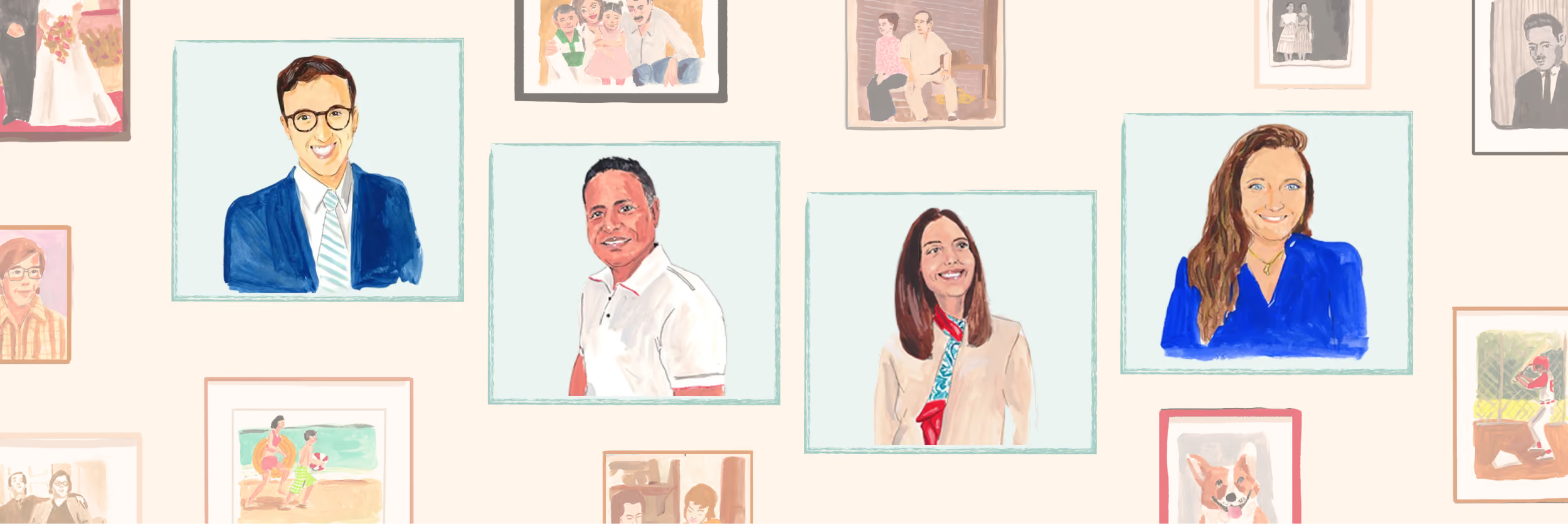
We built it to be simple, guided, and effective. We also incorporated painted illustrations that everyone can relate to, making it warm and personal, so you can make decisions quickly, on your own terms, and get your plan done. We designed a place where your plan can be changed as your life evolves.
This should feel empowering.
Estate planning is more than assets. It’s about the people in your life, your healthcare decisions, your financial responsibilities, and the choices that protect your family.
We believe it can feel different. More approachable. Even a bit unexpected.
A plan, finally complete.