


The Trust You Signed Might Not Be the Trust You Need
Think your trust protects you from nursing home costs? Many don't. Learn the real difference between revocable and irrevocable trusts before you need to know.
The Trust You Signed Might Not Be the Trust You Need
Think your trust protects you from nursing home costs? Many don't. Learn the real difference between revocable and irrevocable trusts before you need to know.

A private nursing home room now runs about $11,250 a month in most parts of the country, according to 2026 estimates from the American Council on Aging. In some states it is closer to $32,000. That is not a scare number, it is just the going rate for care many of us will need someday.
Here is the part that surprises people: a lot of folks who already have a trust assume they are covered for exactly this. Often, they are not. Not because their trust is bad, but because it was built to do a different job.
This Week's Legal Insight
Trusts generally fall into two families, and each one is built for a different purpose.
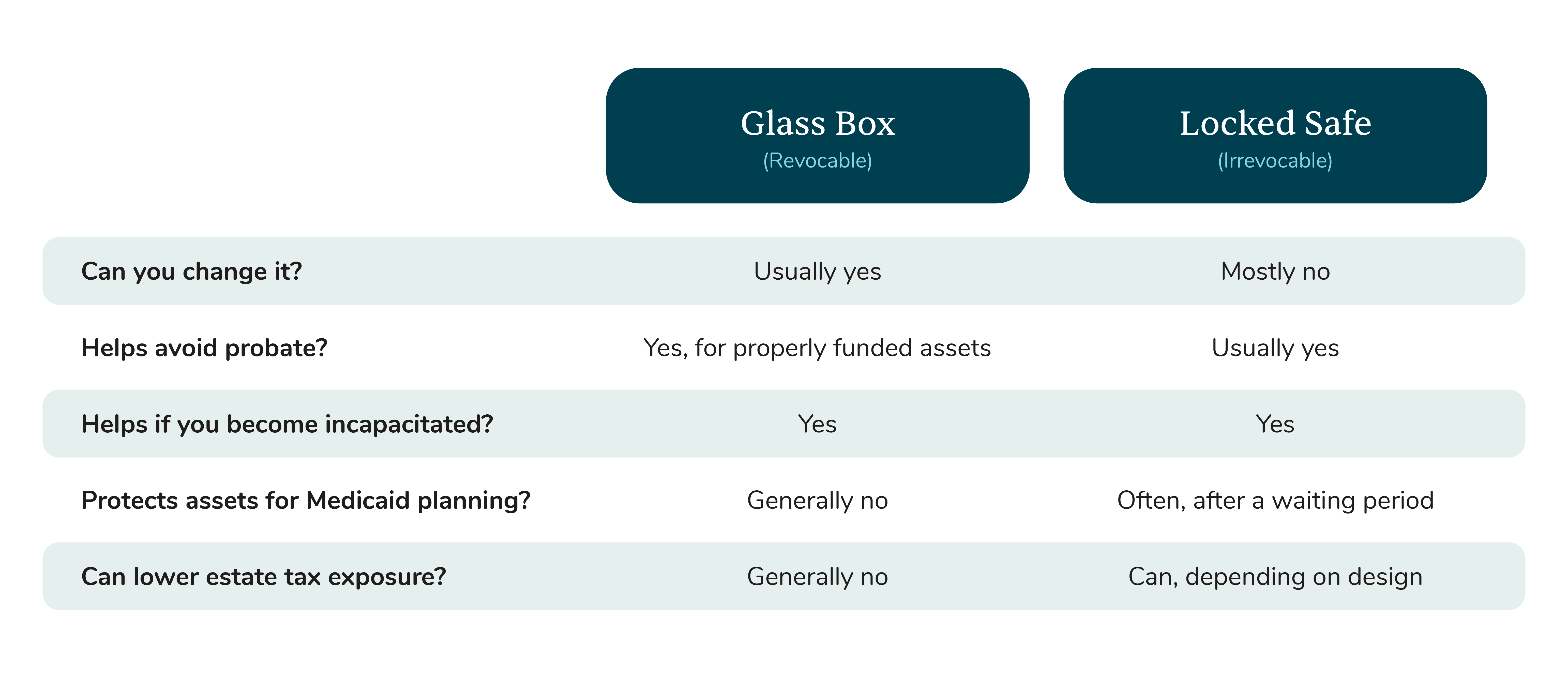
A revocable trust is like a glass box. You put your things inside, and you can still reach in, rearrange them, or take everything back whenever you want. You usually manage it yourself, and if you become incapacitated, a backup person you chose can step in without a court order. It is a great tool for avoiding probate and keeping your affairs private and organized.
An irrevocable trust is more like a safe with restricted access. You hand control to someone else to manage, and you generally cannot undo it or take the items back on your own. That loss of control is exactly why it can offer real protection, though the actual protection depends on how the trust is written.
The short version: control and protection pull in opposite directions. The more of one you keep, the less of the other you get.
A Family, Just to Make It Real
Ray is 71, a retired mechanic, and proud that he "did everything right." Three years ago he paid a lawyer to set up a trust. He tells his daughter Dana the house and savings are locked up safe.
Then his neighbor moves into a nursing home, and the bills start running thousands of dollars a month.
Dana: Dad, are you worried about the nursing home thing?
Ray: Nope. Everything's in my trust.
Dana: Can you still change the trust whenever you want?
Ray: Sure, that's the best part. I control everything.
Dana: Dad, that might be the problem.
If you can take assets back whenever you want, the law usually treats them as still yours. Ray built a great glass box. He just needed a safe too, and never knew it.
The Analogy
Think of estate planning like building a house, floor by floor, not starting at the top.
Floor 1 is the foundation: a will, a financial power of attorney, a healthcare directive, and up-to-date beneficiary designations. Floor 2 is knowing what you own and how it is titled. Floor 3 is the glass box, a revocable trust, for privacy and smooth handling if you are incapacitated. Floor 4 is the locked safe, an irrevocable trust, for people whose biggest worry is long-term care costs. Floor 5 is bringing in the right specialists: an elder law attorney, an estate planning attorney, a CPA, and a financial advisor.
Most people hear "irrevocable trust" and think it is step one. It is usually step four, and it comes with its own timing rules. Federal law applies a five-year look-back period for most Medicaid long-term-care transfers, so moving assets and needing care too soon can trigger a penalty period. That is a big part of why people who plan early, while healthy, end up with more options.
The Takeaway
A trust is not one tool, it is two different tools that happen to share a name. One is built for control and convenience. The other is built for protection, and it asks you to give up control to get it. Knowing which one you have, and whether it actually holds what you think it does, is worth checking today rather than during a crisis.
One Thing to Check This Week
Pull out your estate documents and find out whether your trust is revocable or irrevocable, and whether it was ever actually funded, meaning your house and accounts were retitled into it. An unfunded trust protects nothing, no matter what kind it is.
This is educational content, not legal advice. Trust and Medicaid rules vary by state, and a licensed attorney in your state can tell you what applies to your situation.